Compositional Strategies for Quick Birding Sketches
Compositional Strategies for Quick Birding Sketches
Birds move. For many observers that fact dictates a particular set of compositional and mark-making choices: how to get the essence before the subject flies. This studio-note compares three strategies—gesture drawing, thumbnail composition and selective detail—so you can practice each and see how they influence what you remember and later develop.
Gesture drawing: capturing motion and posture
Gesture drawing is fast, loose and focused on posture and rhythm. Use a soft pencil or felt-tip marker to indicate the curve of the spine, the tilt of the head, and the balance of wings and tail. The goal is not accuracy in feather detail but the sense of energy and weight. Quick gestures can be done in under thirty seconds and are excellent for training visual shorthand.
Gesture work helps with later composition because it records behaviour—how a bird perches, preens or peers—rather than fixed measurements. Repeating short gesture studies of the same species across different contexts builds a mental library of typical poses.
Thumbnail composition: planning a finished page
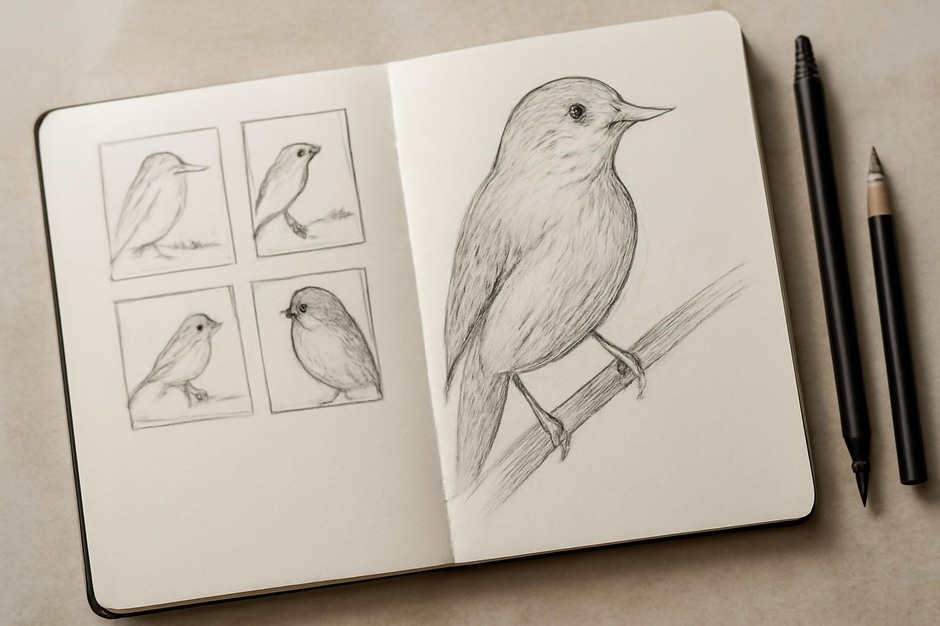
Thumbnails are small, rough layouts that explore relationships between bird, branch and background. They are most useful when you have a little more time or when you want to plan a larger study in the studio. Quickly indicate the bird’s approximate size and placement relative to negative space. Thumbnails can test cropping and balance: is it more dynamic to show the bird facing right or left? Should the composition be vertical to emphasize a tall perch?
Because thumbnails are small, they force decisive choices. They are also forgiving; many thumbnails can fit on a single page, making iterative planning practical in the field.
Selective detail: saving a focal moment
Selective detail focuses on one informative element—eye, beak, foot—rendered with higher fidelity while surrounding marks remain loose. This approach is useful when a bird is visible only briefly but you want to retain a specific diagnostic detail for later study. Use a quick gesture to lock in posture and then spend a minute or two on the chosen detail. The result keeps both context and a key identification feature.
Combining strategies
Often the most useful workflow combines methods. Start with a few gestures to warm your eye, make a thumbnail to try placement ideas, then add a selective detail if time allows. Over the course of an observation session you might progress from gestures to thumbnails to a more resolved studio painting informed by field notes.
Field notes and practical tips
- Work with a small page grid: divide a page into quarters to organize gestures and thumbnails.
- Use minimal colour: a single wash or one coloured-pencil accent can communicate species-specific hues without slowing progress.
- Record short notes about behaviour, call, and habitat to support later work.
Practice makes quick decision-making reliable. Try a timed exercise: spend five minutes on repeated gestures, then five minutes on thumbnails, and finish with five minutes on one selective detail. Compare results and note which strategy best supports your memory and later studio work. The point of these approaches is not to fix a single correct method but to expand your practical toolkit for different field conditions and observation goals.